Clendenin Method - The Four Words
Clendenin Method
-The Four Words
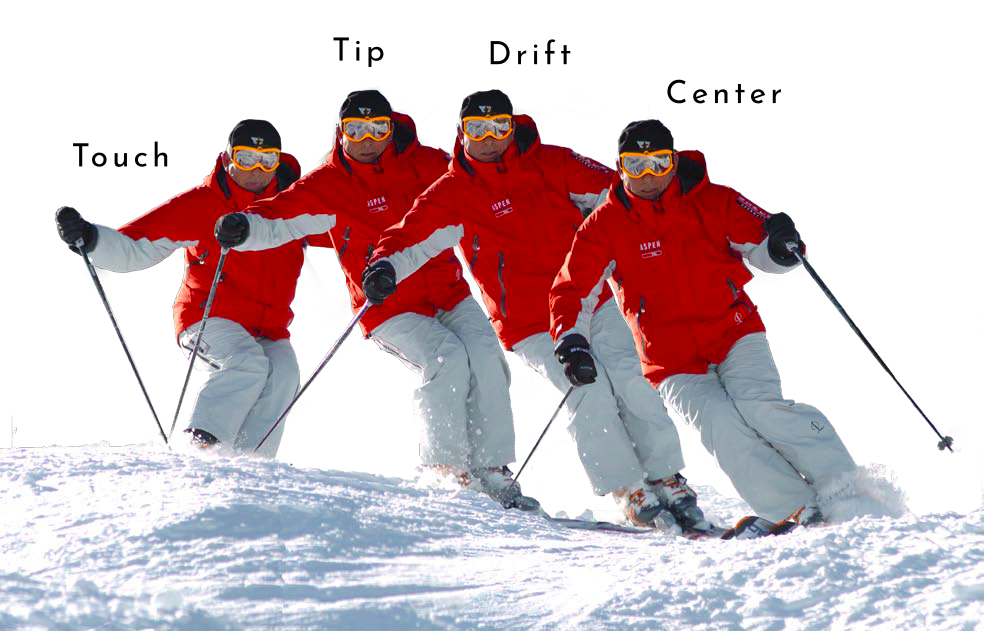
The Clendenin method leverages four simple words to help skiers take ownership of their skiing. These four words encapsulate everything about good skiing, everything we teach ties back to one or more of the four words, and the words serve as learning cues for skiers as they work on their technique.
The Four Words:
Drift, Center, Touch and Tip.
Touch
The word 'touch' refers to what we do with our hands and poles, most importantly the pole touch that cues the release into the new turn.
Tip
The word 'tip' refers to how we manage the angles of the ski edge relative to the snow.
Drift
The word 'drift' refers to how one intentionally manages the path they travel across the hill. Drifting is the art of shaping the turn.
Center
Centering is the continuous process of maintaining equilibrium. The word 'center' refers to this process, and how we learn to identify whether we are centered by waking up to sensations in our feet.
Why Four Words?
Students often arrive at our camps confused. Most come with a collection of confusing and contradictory ideas garnered from articles, lessons, and well-meaning friends.
They have failed to synthesize the tangle of information in a way that creates lasting value. They need a way to organize and structure what they learn.
That's why our teaching methodology is based on four simple words: Drift and Center, then Touch and Tip, and on and on down the mountain. In a basic sense, we are drifting and centering all the time. When we want to turn, we touch and tip. These words describe the fundamental movements of all great skiers and provide an efficient framework for campers, clients, and you the reader… to understand and assimilate information.
Touch
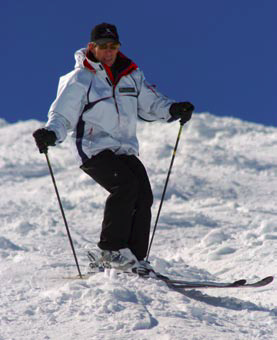
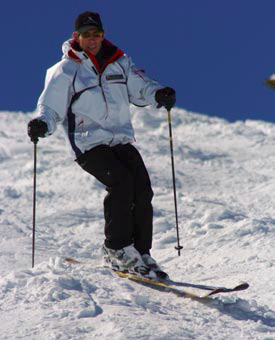
Touching is managing our poles, especially how and when they contact the snow.
Most skiers do not realize the importance of their ski poles. How one carries and uses their poles is crucial and, fortunately, easy to learn. In bumps, skiers who stem use a firmly planted pole as a brace to transfer weight onto a stemmed ski.
The Clendenin Ski Method™ pole touch functions to cue the feet to tip and release edge grip, not as a crutch to transfer weight. Understanding the proper function of the poles changes the way we carry our poles and immediately improves the way we ski.
The Touch relates both to the skill of appropriately swinging the pole to contact the snow and the sensations in the hand as the pole makes contact. The touch is the most important timing element of a turn.
The Touch also commits the center of mass into the “new turn’s” path of momentum.
Commitment is a proactive move of the body into the new turn—into our new path.
This commitment of the center down the hill enables the skier to release edges
effortlessly, creating a smooth, expert transition from one turn to the next. This
proactive move separates a defensive skier who stems, from one who flows.
Tip
Tipping is changing the ski edge angle to the snow.
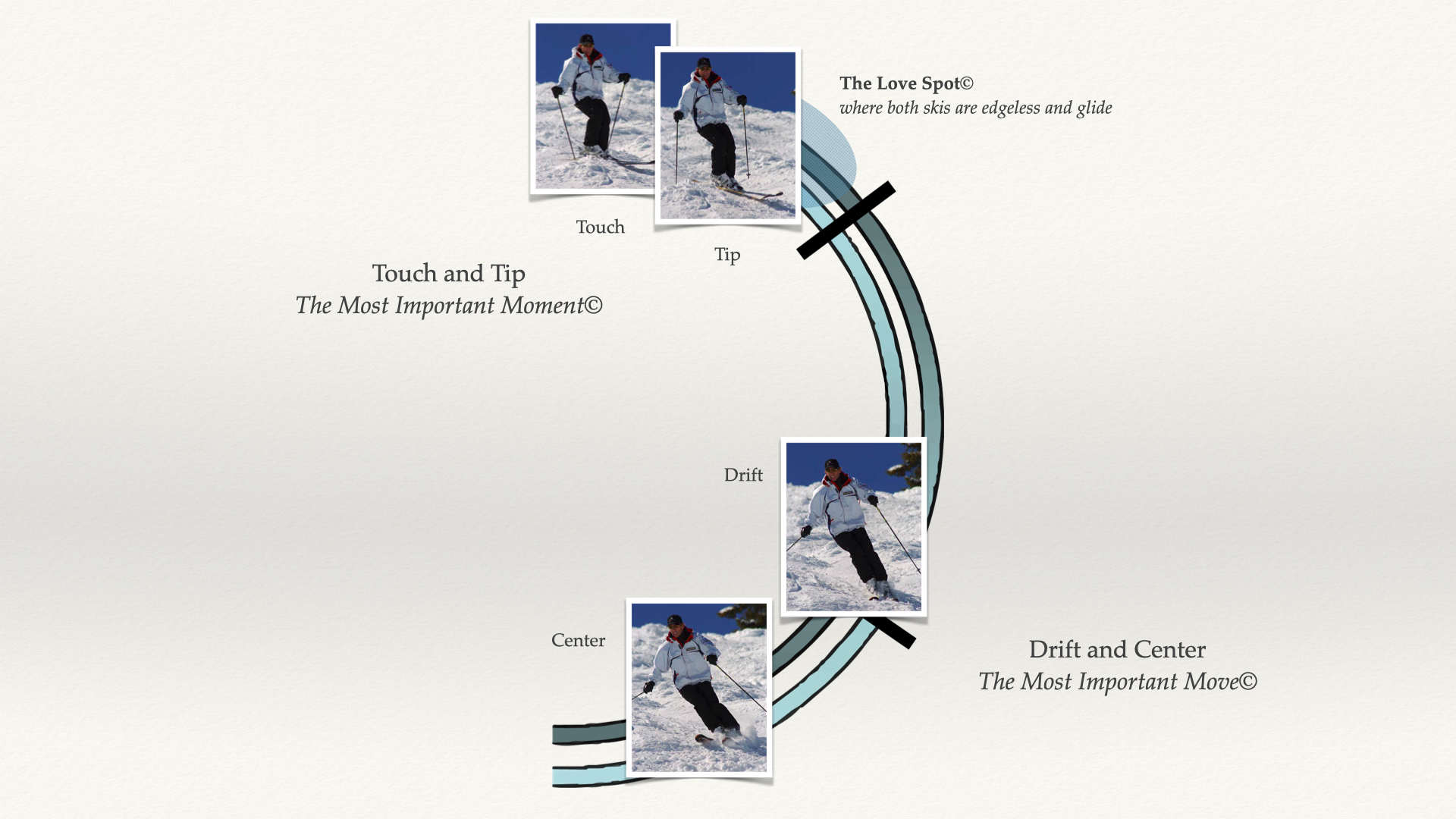
The Most Important Moment© in Skiing
When finishing a turn, great skiers are on uphill edges. To enter a new turn, they tip their feet downslope releasing their edges. Releasing uphill edges (tipping feet downslope) automatically initiates the turns of all great skiers.
During the edge change, skis go through a phase, however fleeting, in which they are flat on the snow. When flat and edgeless, skis are gliding or floating. We call this edgelessness the "Love Spot©" as our clients love the bumps when they discover the skill of gliding. As the tipping movement continues, we change direction and new uphill edges are engaged. The skier controls speed and direction by regulating the amount of edge being released or engaged. Tipping is changing the ski edge angle to the snow.
The Most Important Moment© in skiing is the moment we end one turn to begin the next. In this moment many skiers—maybe most skiers—habitually rush through turn initiation at the start of each new turn. They step, hop or twist skis as rapidly as possible through this moment, to seek the “safety” of their new edges. Unfortunately, these skiers literally skip the “Most Important Moment©”. This is the moment that plays the most important role at the top of the turn. Here, great skiers maintain ski/snow contact. This is when they release and guide their center-of-mass along the path of momentum down the mountain. It is in this moment that fluid, flowing, centered skiing lives or dies.
Drift
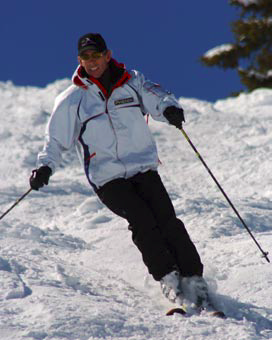
Drifting is the art of shaping the turn.
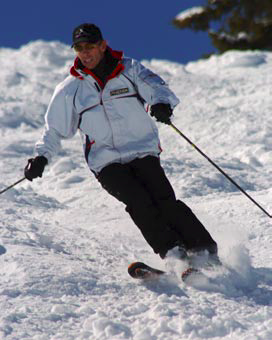
Like a snowflake, each turn has a unique shape. When we control and create our intended turn shape, we drift. Each drift is created through skilled use of edge angles combined with movement of the body mass over the skis.
When carving, edges are used aggressively to maximize speed. For all-mountain skiing, focus is on softening or feathering edges to shape turns and control speed. The flatter the edge angle to the snow, the softer the edge. The more one practices using soft edges on groomed terrain, the more one becomes responsive to subtle sensations of balance in their feet.
Great skiers posses the ability to regulate edges when drifting—finessing or feathering the edges—as needed for various tasks, including shedding excess speed in moguls. They manage a spectrum of turn shapes from hard-edge, hard-snow carving turns, to long, lazy, mega- radius, soft-edge turns. This skill of feathering the edges to shape the drift is essential not only for efficient mogul skiing, but for all high-level skiing. Drifting turns for varying shapes allows the skier either to maximize speed, as in a race-course, or to control speed, as in moguls.
Center
Centering is the continuous process of maintaining equilibrium.
Great skiers continuously realign their center of mass to their feet to maintain optimum equilibrium. Realignment can be either a cross-over move (mass over feet) or cross-under move (feet under mass). Centering is commonly thought of as a front-to-back action, but we are addressing equally, if not more, side-to-side or foot-to-foot centering. Centering also provides invaluable sensory feedback that affects the turn. The more sensitive the skier is to feedback provided by pressure sensations in the bottom of the feet, the more centering becomes instinctual. When centered, our bones are stacked. Stacked bones allow our relaxed muscles to function at optimum performance levels. A centered skier can flex or extend freely to maintain ski-snow contact.
Centering is a flowing, dynamic process rather than a static position. Centering allows us to balance at will on either foot. When we change our primary balance from one foot to the other we are re-centering. Identifying these sensations in the bottom of the feet is an axiom of the Clendenin Ski Method™.
Center to Re-Center – the Most Important Move©
The second of our Four Words©, Center, describes the orientation of the skier’s center-of-mass, both fore/aft and from ski to ski. When centered we can balance on either ski. When balanced on one ski, all our weight is pressuring that ski. When we shift our balance from the downhill ski to the uphill ski, from a big-toe edge to a little-toe edge, from a big toe pad to the EP, we re-center,
the Most Important Move© in skiing.